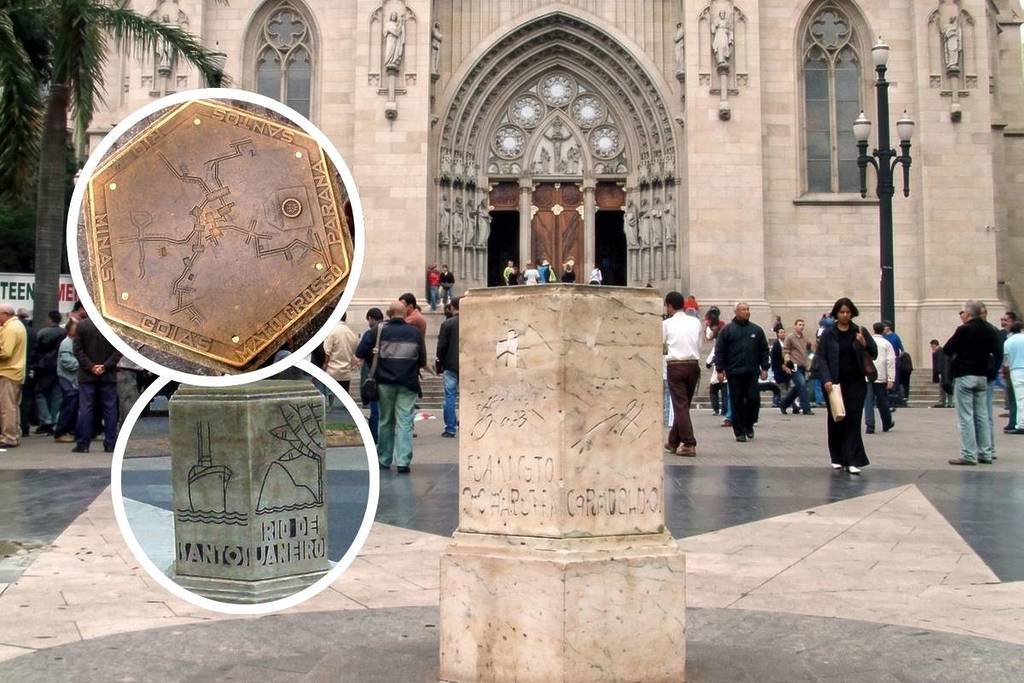

Installed in 1934, São Paulo’s Marco Zero is located in the heart of the capital, across from the Sé Cathedral. Its original function was to organize the numbering of local residences and calculate the distance from São Paulo highways to the state’sborders . Historians and researchers affirm that, currently, the monument serves as a central reference point for the numerical ordering of all the city’s streets.
Furthermore, Marco Zero still represents the official geographic center of the city of São Paulo. Over the decades, the monument has established itself as a symbol of identity for those passing through the central region. It serves as a visual guide, connecting the metropolis with the rest of the country.
The symbolism and details of Marco Zero
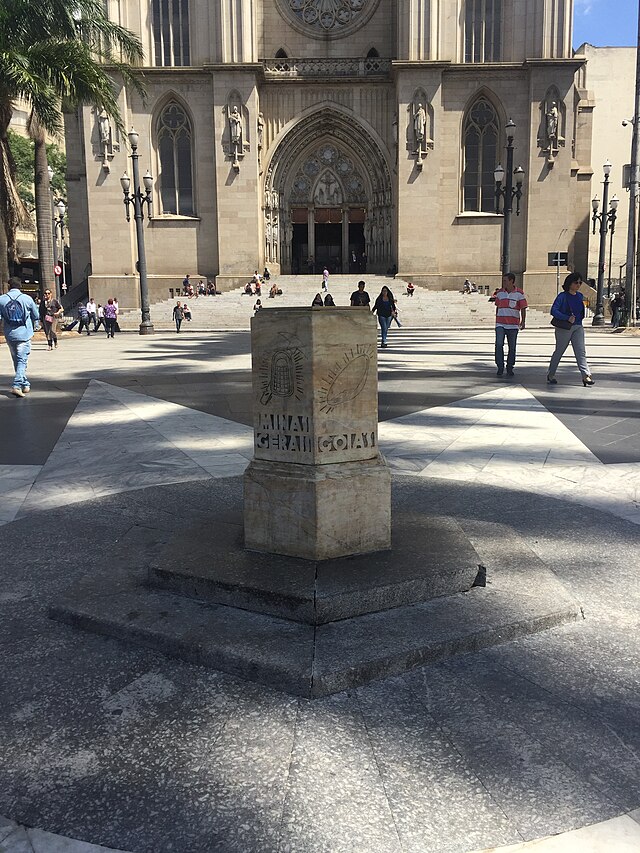
Its structure consists of a hexagonal prism, clad in marble, with faces displaying engravings indicating the directions of Brazil’s states and cities. Each side pays homage to a specific location with elements that represent it. Rio de Janeiro features Sugarloaf Mountain, while Paraná displays the Araucaria tree and Minas Gerais features mining tools.
Other directions include Santos, illustrated by a steamship. And states such as Goiás and Mato Grosso, represented by a gold panning pan and bandeirante attire, respectively.
Iconic symbols are not mere adornments, but a historical and cartographic representation of the connections that extend from the capital toward the interior and the coast.
Historical heritage and urban cartography
At the top, there is a bronze plaque displaying a partial map from the era, dated 1934, donated by the Touring Club of Brazil. One can also identify major thoroughfares such as Paulista Avenue, São João Street, and Celso Garcia Street, as well as prestigious institutions like the School of Medicine and the Ipiranga Museum.
As a result of its cultural significance, São Paulo’s Marco Zero was designated a historic landmark in 2007. This official recognition preserves not only the physical structure but also the sense of belonging to São Paulo—and the central role the city played in the development of various other regions of the country.